The Standard Information Gathering (SIG) questionnaire is the industry’s most-used third-party risk assessment — 21 risk domains, 133 to 810 questions depending on edition, mapped to NIST CSF 2.0, HIPAA, GDPR, SOC 2, ISO 27001, EU AI Act, and 30+ frameworks. Vanta automates the same vendor-attestation pattern continuously: 16,000+ customers, 400+ tool integrations, hourly automated control tests. Drata, Secureframe, and OneTrust do the same. Each is a strong tool for the sanctioned vendor risk-management job it was built for.
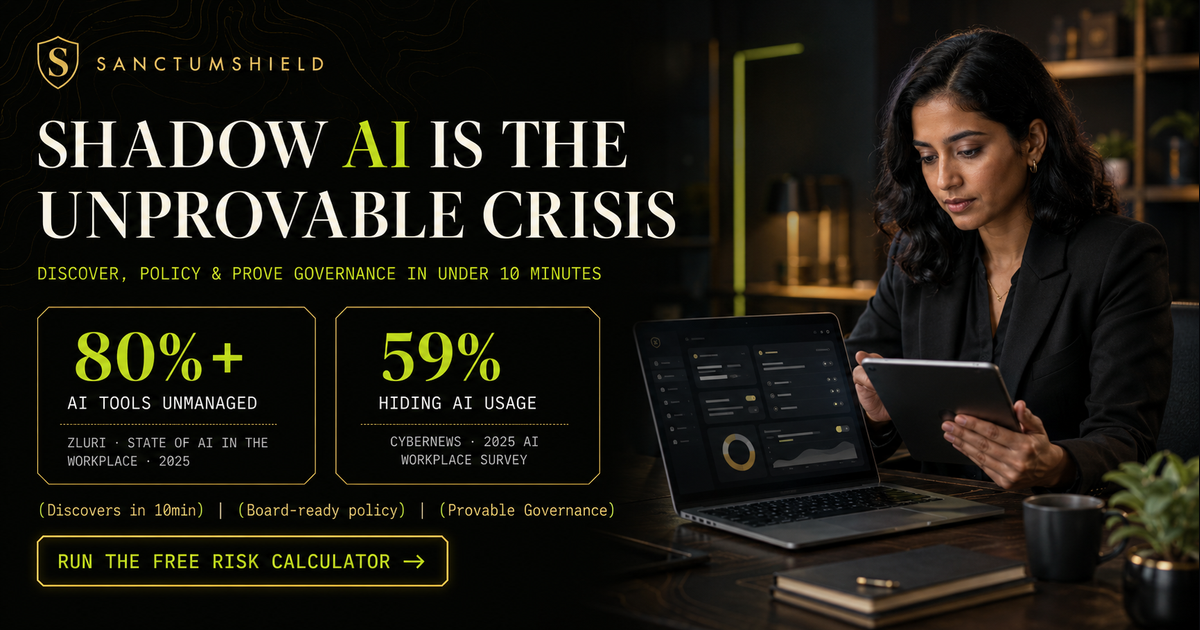
Each is also, structurally, a vendor self-attestation framework. SIG, Vanta, Drata, and Secureframe all see the AI tools your security team has onboarded. None of them can see the consultant who pastes a customer contract into ChatGPT, the engineer who installs an AI browser extension on a managed laptop, or the analyst who authenticates to Claude or Gemini with personal credentials outside IT. The 80%+ of enterprise AI usage that is unmanaged is the AI these tools were never designed to detect — because Shadow AI is not a vendor relationship, it is an employee behavior. See the SIG entry in the glossary for the parent acronym, and How SanctumShield works alongside the SIG questionnaire for the full structural critique.
What to do. Keep your vendor-attestation tools — they are doing the vendor-risk job correctly. Layer Shadow AI governance alongside them. SanctumShield runs observation against network logs (paste any firewall, proxy, or DNS export — no integration, no agent, no platform engineer required), matches outbound traffic against 118 continuously-refreshed AI endpoints via multi-LLM agentic synthesis (Claude + Gemini), generates a regulation-anchored AUP, and produces a board-ready Executive Risk Report with a 6-year verifiable URL that underwriters and auditors can confirm. SIG and Vanta cover the vendor program. SanctumShield covers the employee program. Next step: see how SanctumShield layers under Vanta at /vs-vanta.