Google Cloud Next ’26 (April 2026) formalized a new category of enterprise software: Agent Governance. The category covers AI agents, MCP (Model Context Protocol) servers, A2A (agent-to-agent) discovery chains, and the autonomous AI tools increasingly acting on enterprise systems without continuous human oversight. Google’s five-pillar architecture — Agent Registry, Agent Gateway, Agent Identity, Pluggable Policies, Agent Observability — is the most thorough public articulation of how to govern this surface to date. It is also designed for the Fortune 1000 with a platform engineering team.
The existing security stack — IAM (Identity and Access Management), SIEM (Security Information and Event Management), GRC (Governance, Risk, and Compliance), CNAPP (Cloud-Native Application Protection Platform), and even AI-SPM (AI Security Posture Management) platforms like Wiz and Palo Alto AI Access — was not built for this category. It governs human accounts, not autonomous agent identities. It enforces network controls, not delegated-authority policies. It observes runtime telemetry, not the regulation-anchored AUP a board signs. The category is new, not a renamed AI-SPM, and the mid-market (50–2,000 employees) needs a companion to Google’s architecture that does not require a platform engineering team to deploy.
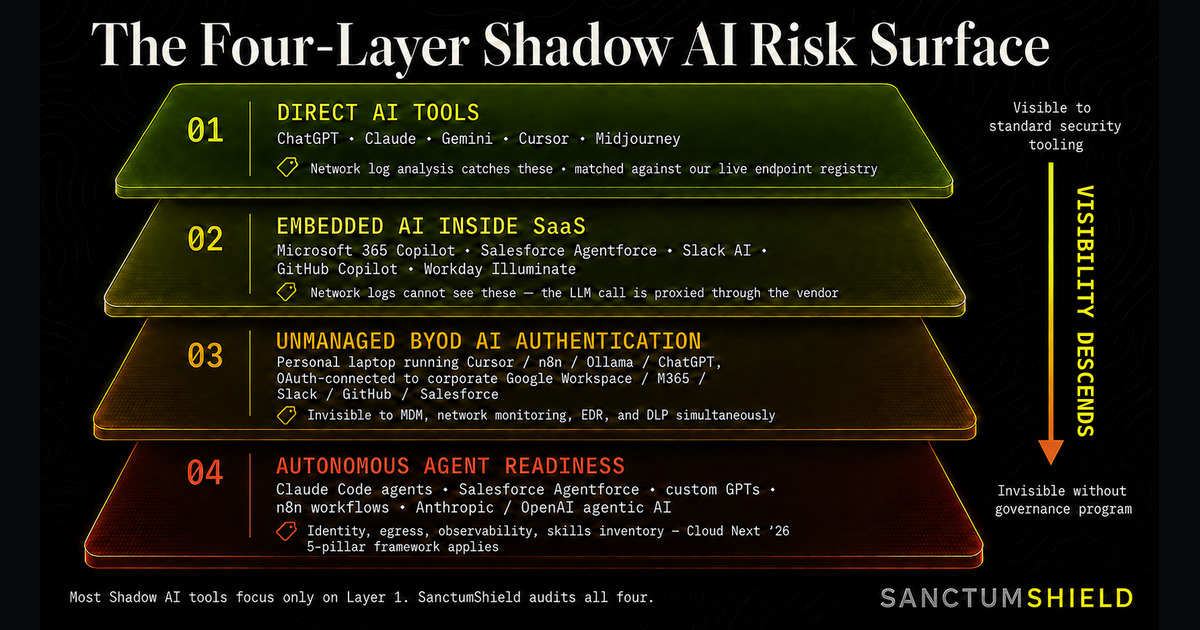
What to do. Treat Agent Governance as its own discipline. Understand the four-layer Shadow AI risk surface (Layer 4 is the agentic layer). Produce a regulation-anchored AUP that includes a Deployed Agent Policy section. SanctumShield generates that AUP — Section 14 explicitly covers agent registration, MCP server allowlisting, A2A discovery boundaries, agent identity and credentials, kill-switch procedures, and agent-authored code governance — in 10 minutes with no platform engineering required. Multi-LLM agentic synthesis (Claude + Gemini) cross-validates every clause at generation time. Next step: see the Layer 4 audit in a real Acme Health artifact at /sample-outputs.
October 2026. Google has now put the deployer's responsibility in contract as well as in product. Its Agentic AI Responsible Use Guidelines, last modified October 12, 2026, state that "it is your responsibility to determine your governance obligations," and its Service Specific Terms define an "Agentic AI Action" to include an agent's inaction and disclaim liability and indemnity for customer and third-party agents (SST Sections 14 and 19(b)). The category Google formalized at Cloud Next is now matched by terms that assign its governance to the customer. The governance artifact that records those decisions remains the customer's to produce.